

The unique concept of ‘less clothing leads to higher defense‘ exists in electronic gaming culture, especially targeting the male consumer demographic and their consumption of digital female character images. Can you imagine the phenomenon of screens offering us less visual information but triggering more imagination? Does composition still hold significance for virtual cameras?
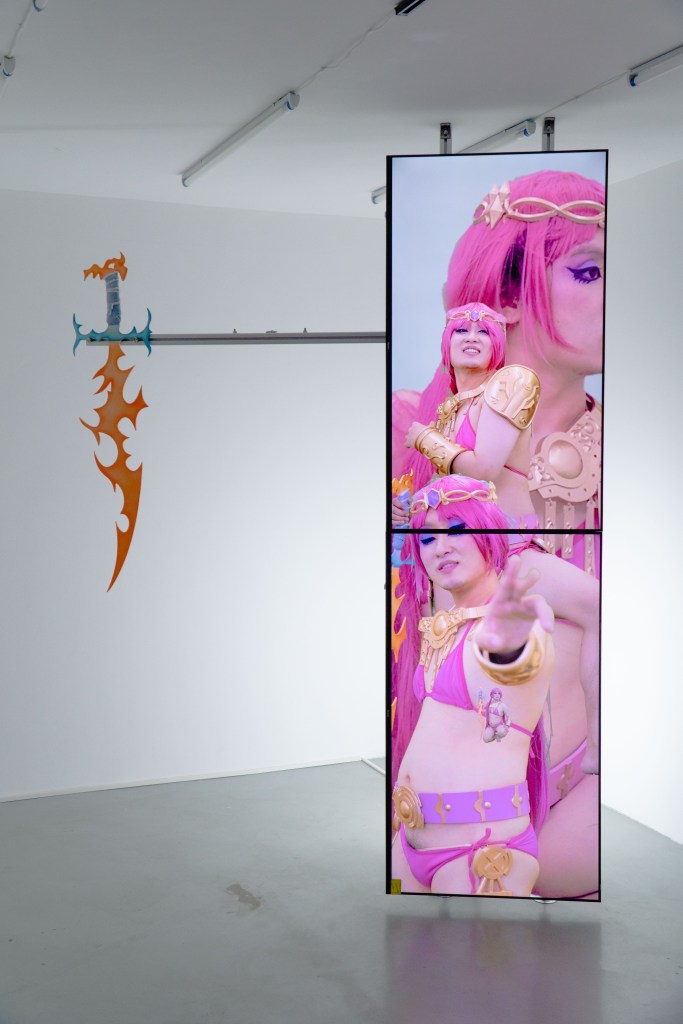
2 Screen Video, 55″ TV, Aluminium Steel Frame, 00’03’45
Hey, can you see these twisting pixels clearly? They’re part of an animation created by a 40×40 pixel matrix. To make it easier for you to observe without getting too close, I’ve enlarged the pixels by 10 times. The moving pixels depict a female warrior character seemingly clad in bikini armor, wielding a sword. Her sword sways in her hand, ready for combat, her chest rises and falls with each breath, and her sturdy thighs hint at a sense of sensuality.
Since when did screens start becoming narrower? In my perspective, the aspect ratio of images has greatly altered our viewing habits. When the screen’s aspect ratio shifted from the original 4:3 to 16:9, visual information expanded across the wider screen. This wrapping of information draws us deeper into the presented visual image. Conversely, portrait mode achieves the opposite effect by reducing peripheral visual information, concentrating the user’s attention. The marriage of mobile hardware and software with individualistic thought has significantly shaped new habits of image capturing and appreciation. From front-facing camera applications to online streaming, the head and upper body occupy the majority of screen space, allowing for a more direct and unfiltered gaze. This is particularly prominent in explicit live broadcasts, where genital shapes adapt to the portrait screen, resulting in an infinite enlargement of these features. This, in turn, erases one’s presence in the image, displaying only fragmented and abstracted visuals, which stimulate even more provocative thoughts.
Like this bikini warrior, the less you wear, the higher your defense.
Today’s images don’t need to be composed. The creator has lost sovereignty over the image. Whether it is panoramic photography or webcasting, the control of the lens lies with the audience. Actively seeking shifts or inducing broadcasters to alter angles and postures through donations, the aesthetic significance of composition on a smartphone screen has decayed into a utilitarian tool of desire. Dots, lines, shapes, colors, light, shadow, space, perspective—all these elements are eclipsed by the effectiveness of a standardized beauty filter, and beauty thus falls by the wayside.



 XIAHAN.ART